
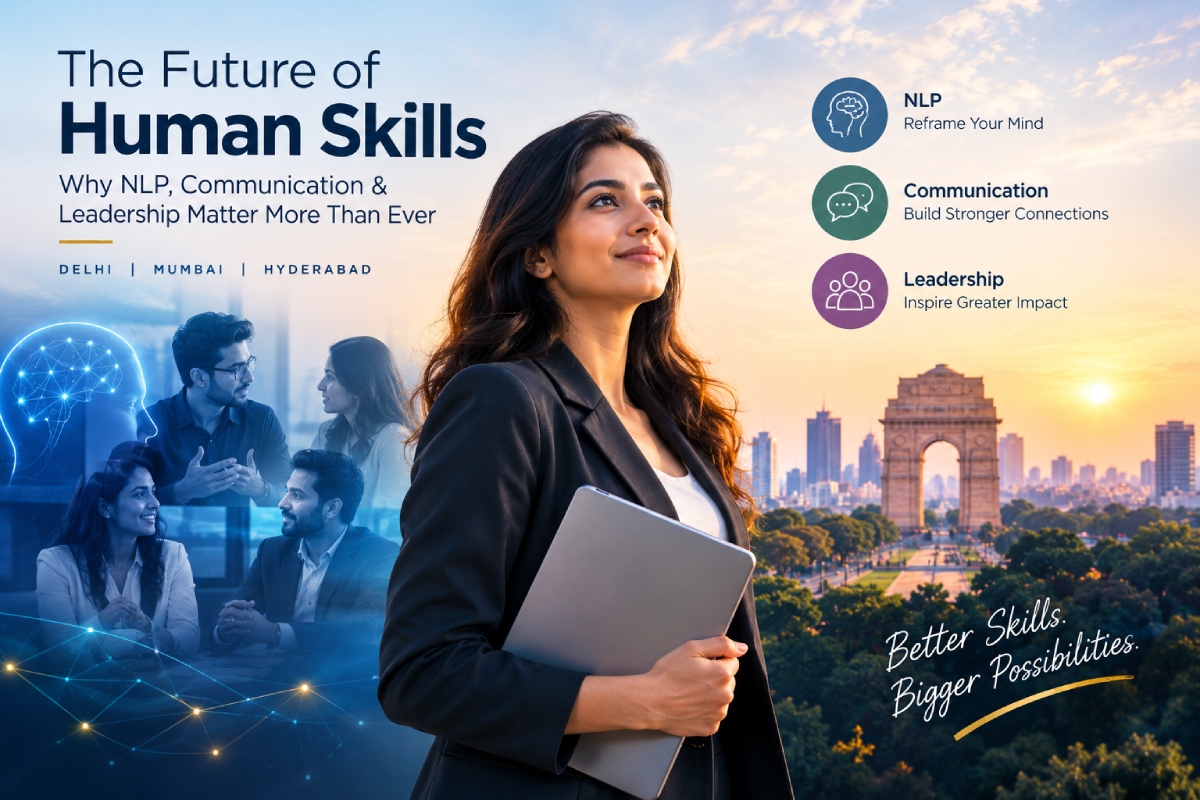

Technology Is Changing Work. But Humans Still Lead It.
The workplace is changing faster than ever.Artificial intelligence is automating tasks. Digital platforms are transforming communication. Data is influencing decisions. Businesses are becoming more connected, competitive and global.
Yet there is one thing technology cannot completely replace.
Human connection.
People still need to communicate.
They still need to build trust.
They still need to understand one another.
They still need to make decisions when there is no perfect answer.
They still need to lead teams, manage conflict, negotiate, inspire and adapt.
This is why human skills are becoming increasingly valuable.
Technical knowledge may help you work with technology.
But communication, emotional intelligence, leadership and self-awareness help you work with people.
And in the future workplace, professionals will need both.
The New Definition of Professional Success
For a long time, career success was strongly associated with qualifications, technical expertise and experience.These remain important.
But they are no longer the complete picture.
Imagine two professionals with similar qualifications and experience.
One struggles to communicate ideas, avoids difficult conversations and becomes overwhelmed under pressure.
The other communicates clearly, listens effectively, adapts to different people and remains composed when circumstances change.
Who is more likely to influence a team?
Who is more likely to build strong professional relationships?
Who is more likely to be trusted with leadership responsibilities?
The difference may not be technical knowledge.
It may be human capability.
What Are Human Skills?
Human skills are the capabilities that influence how effectively we interact with ourselves and with other people.They include:
• Communication
• Emotional intelligence
• Self-awareness
• Leadership
• Active listening
• Empathy
• Collaboration
• Decision-making
• Adaptability
• Confidence
• Conflict management
• Influence
• Creativity
These capabilities are relevant across almost every profession.
Whether you work in technology, healthcare, education, finance, consulting, sales, entrepreneurship or management, your ability to work with people remains important.
Why Communication Will Become Even More Valuable
As information becomes easier to access, the ability to communicate that information effectively becomes more important.Professionals need to explain complex ideas simply.
Leaders need to communicate vision.
Managers need to give feedback.
Sales professionals need to understand customers.
Entrepreneurs need to communicate their ideas.
Teams need to collaborate across departments and locations.
The challenge is not simply speaking.
The challenge is creating understanding.
Good communication involves listening, questioning, clarity, emotional awareness and the ability to adapt your message to different people and situations.
NLP and the Human Side of Professional Development
Neuro-Linguistic Programming, commonly known as NLP, explores the relationship between thoughts, language, emotions and behaviour.This makes it relevant to many of the human skills required in modern professional environments.
NLP encourages individuals to become more aware of how they think, how they communicate and how their internal patterns influence their actions.
For example, a professional may know exactly what needs to be said in an important meeting but still hesitate to speak.
Another may have excellent ideas but struggle to communicate them confidently.
Someone else may react defensively whenever they receive criticism.
Understanding these patterns can create an opportunity for more conscious responses.
Awareness can create choice, and choice can create better behaviour.
Self-Awareness Is Becoming a Professional Advantage
Self-awareness is sometimes treated as a personal-development concept.It is actually a professional capability.
A self-aware professional can recognise:
What situations trigger stress.
How they respond to criticism.
Where they communicate effectively.
Where they tend to hesitate.
What motivates them.
What beliefs influence their decisions.
How their behaviour affects other people.
This awareness makes development more targeted.
Instead of simply saying, “I need to become a better leader,” you can ask:
“What specific behaviour is limiting my leadership effectiveness?”
That question creates a much clearer path for improvement.
Emotional Intelligence in the Age of AI
As technology handles more routine and analytical tasks, emotional intelligence can become even more important.A machine can process information.
A human leader still needs to understand how people feel about a decision.
A system can generate a response.
A professional still needs to understand whether that response will build trust.
Technology can support productivity.
Human beings still create relationships.
Emotional intelligence involves recognising emotions, managing responses, understanding perspectives and maintaining productive relationships.
These capabilities become especially important during uncertainty and change.
Why Future Leaders Need More Than Authority
Leadership is changing.The traditional idea of leadership often focused on authority, control and decision-making power.
Modern leadership requires something deeper.
People want leaders who listen.
They want leaders who communicate honestly.
They want leaders who create psychological safety.
They want leaders who can make difficult decisions without losing empathy.
They want leaders who develop people rather than simply manage tasks.
The future leader will increasingly be judged not only by what they achieve, but by the people they help become better.
The Shift From Managing Tasks to Developing People
A manager can assign work.A leader develops capability.
A manager can monitor deadlines.
A leader creates ownership.
A manager can identify mistakes.
A leader turns mistakes into learning opportunities.
This shift requires strong communication and emotional intelligence.
It also requires understanding that different people respond differently to feedback, pressure, recognition and responsibility.
There is no single communication style that works perfectly for everyone.
Effective leaders become flexible.
Adaptability Will Define Future Careers
The future of work will not remain static.Roles will change.
Skills will evolve.
Industries will transform.
New technologies will emerge.
Professionals who depend entirely on one fixed skill set may find adaptation difficult.
The ability to learn, unlearn and relearn will therefore become increasingly important.
Adaptability is not about constantly changing direction.
It is about being willing to adjust when circumstances require it.
NLP can complement this mindset by encouraging greater flexibility in how individuals interpret situations and respond to challenges.
Confidence Without Arrogance
Professional confidence is another important human skill.But confidence is not the same as being the loudest person in the room.
Healthy confidence means being able to express your ideas while remaining open to other perspectives.
It means asking questions when you do not know something.
It means taking responsibility when you make a mistake.
It means entering challenging situations without assuming that you must be perfect.
NLP-based approaches can help professionals examine the internal dialogue that influences confidence and identify patterns that may be holding them back.
Listening May Become More Valuable Than Speaking
In a world filled with information, everyone has something to say.Very few people truly listen.
Active listening can become a major professional advantage.
A strong listener pays attention to:
• The words being spoken
• The emotion behind the words
• The person's concerns
• The assumptions involved
• What is not being said
• The outcome the person wants
Listening can improve leadership, sales, negotiation, coaching, customer relationships and teamwork.
Sometimes the fastest way to solve a communication problem is to stop trying to explain and start trying to understand.
Human Skills and Career Growth
Career advancement often depends on more than technical performance.At senior levels, professionals increasingly need to influence rather than simply execute.
They need to present ideas.
They need to manage stakeholders.
They need to negotiate.
They need to mentor others.
They need to handle conflict.
They need to represent their organisation.
They need to make decisions under uncertainty.
This is why investing in human skills can support long-term career development.
The higher you move in an organisation, the more your ability to work through people can influence your impact.
Why NLP Training Matters for Hyderabad Professionals
Hyderabad has become a major hub for technology, healthcare, pharmaceuticals, global businesses, consulting, education and entrepreneurship.The city's professional environment brings together people from different industries, cultures, backgrounds and levels of experience.
That diversity creates opportunity.
It also creates a greater need for communication and adaptability.
For professionals considering NLP Training in Hyderabad, NLP can be explored as part of a broader development journey focused on communication, confidence, emotional awareness, leadership and interpersonal effectiveness.
The objective should not simply be to collect another certificate.
It should be to develop capabilities that can be applied in real situations.
Human Skills Are Not Limited to Hyderabad
The same need exists across India's major professional centres.In Delhi, professionals work across corporate, government, consulting, education, entrepreneurship and service sectors.
In Mumbai, professionals operate across finance, media, entertainment, business, consulting, technology and entrepreneurship.
Different industries.
Different cultures.
Different opportunities.
But the need for effective human interaction remains remarkably consistent.
This is why the principles of NLP, communication and leadership can have relevance across cities and professions.
The Role of NLP in Leadership Development
Leadership involves managing your own state before influencing others.A leader who becomes overwhelmed during pressure may communicate poorly.
A leader who assumes negative intentions may escalate conflict.
A leader who cannot listen may miss valuable information.
A leader who constantly doubts themselves may struggle to inspire confidence.
NLP can provide frameworks that encourage greater awareness of internal states, language patterns, perspectives and behavioural responses.
This can complement leadership development by helping professionals become more intentional in the way they communicate and respond.
Communication, NLP and Corporate Development
Organisations are also recognising that employee development cannot focus only on technical skills.Teams need people who can collaborate.
Managers need to communicate effectively.
Leaders need to influence.
Employees need to handle change.
Customer-facing professionals need to build trust.
This makes human-skills development relevant at an organisational level.
NLP Corporate Training in Hyderabad can be one approach organisations explore when developing communication, interpersonal effectiveness, confidence and leadership capabilities within teams.
The most useful corporate programs are those that connect learning with actual workplace situations.
The Future Belongs to Hybrid Professionals
The most successful professionals of the future may not be those who choose between technology and human skills.They will combine both.
A technology professional who can communicate with clients.
A data professional who can explain insights to leadership.
A healthcare professional who can combine expertise with empathy.
An entrepreneur who can use technology while building strong relationships.
A manager who understands both business performance and human behaviour.
This combination creates a powerful professional profile.
Technical capability creates efficiency. Human capability creates connection, trust and influence.
How to Develop Your Human Skills
Human skills can be developed through deliberate practice.Start with simple actions.
• Listen fully before responding.
• Ask questions instead of making assumptions.
• Notice your emotional triggers.
• Practise communicating complex ideas simply.
• Ask for feedback on your communication.
• Reflect after difficult conversations.
• Become aware of your internal dialogue.
• Practise responding rather than reacting.
• Take responsibility for mistakes.
• Learn to communicate with different personality styles.
• Develop the habit of continuous learning.
The objective is not overnight transformation.
It is consistent improvement.
Learning Should Lead to Application
A common problem with professional development is that people collect information without changing behaviour.They attend a workshop.
They take notes.
They feel motivated.
Then they return to the same habits.
Real development requires application.
If you learn a communication technique, practise it.
If you learn about emotional awareness, observe yourself.
If you learn about leadership, apply it with your team.
If you learn about reframing, use it when facing a difficult situation.
Knowledge becomes valuable when it changes what you do.
Why Choosing the Right Training Environment Matters
If you decide to explore NLP, the quality of the learning environment matters.Look beyond the name of the course.
Consider:
• The trainer's practical experience
• The depth of the curriculum
• Opportunities for hands-on practice
• Relevance to real-life situations
• Interaction and feedback
• The learning environment
• Your personal objectives
A strong training experience should encourage participants to think, practise, reflect and apply.
A New Definition of Personal Growth
Personal growth is not about becoming perfect.It is about becoming more aware.
More aware of your thoughts.
More aware of your emotions.
More aware of your communication.
More aware of your habits.
More aware of your impact on others.
And more capable of choosing how you respond.
That awareness can influence both personal and professional life.
The way you communicate at work can influence your relationships.
The confidence you develop professionally can influence personal decisions.
The emotional intelligence you develop as a leader can influence the people around you.
Human development rarely stays confined to one area of life.
Preparing Yourself for the Future of Work
You cannot predict exactly what the workplace will look like five or ten years from now.You can, however, prepare yourself to adapt.
Build technical knowledge.
Develop digital literacy.
Strengthen communication.
Improve emotional intelligence.
Learn to work with different people.
Develop leadership capabilities.
Become comfortable with change.
Understand your own thinking.
Keep learning.
These capabilities create a foundation that remains useful even as specific technologies and job roles evolve.
Why NLP Remains Relevant
NLP is not valuable because it promises a shortcut to success.Its relevance comes from its focus on areas that remain central to human performance:
How we think.
How we communicate.
How we interpret experiences.
How we respond.
How we relate to others.
These questions will remain relevant regardless of how advanced technology becomes.
The tools around us may change.
The human need for understanding, connection and meaningful communication will not disappear.
Begin With One Human Skill
You do not need to transform everything at once.Choose one area.
Maybe it is communication.
Maybe it is confidence.
Maybe it is listening.
Maybe it is emotional awareness.
Maybe it is leadership.
Maybe it is decision-making.
Work on it deliberately.
Observe the difference.
Then build from there.
Transformation often begins with a small change that is repeated consistently.
Conclusion
The future of work will undoubtedly involve more technology.But the future of leadership, collaboration and professional relationships will remain deeply human.
People will still need to trust.
People will still need to communicate.
People will still need to understand.
People will still need to lead.
People will still need confidence when facing uncertainty.
And people will still need the ability to change.
NLP can be one practical framework for developing greater awareness of the relationship between thoughts, language, emotions and behaviour.
When combined with communication practice, emotional intelligence and leadership development, it can support professionals who want to become more effective without losing their human side.
For professionals exploring NLP Training in Hyderabad, the opportunity is not simply to learn something new.
It is to understand yourself better, communicate more effectively and become more intentional about the professional future you are building.
The future may be powered by technology, but it will still be shaped by people.
And the people who learn to combine technical capability with strong human skills will be better prepared to lead that future.
About Transhuman Consulting
Transhuman Consulting helps individuals and organisations develop human potential through NLP, leadership development, communication training and professional transformation.Paritosh Sharan – Founder & Lead Coach
Transhuman Consulting
Phone: +91 99664 00373
Email: [email protected]
Frequently Asked Questions
1. Why are human skills becoming important in the age of AI?
As technology automates more tasks, skills such as communication, emotional intelligence, leadership, collaboration, adaptability and relationship management remain essential for working effectively with people.
2. How can NLP support professional development?
NLP can help individuals become more aware of their thinking patterns, language, emotional responses and behaviours. This awareness can support development in areas such as communication, confidence, leadership and interpersonal effectiveness.